Financial Literacy in the Classroom: TAPCO’s Partnership with Baker Middle School
A sustained partnership with Baker Middle School is helping students build practical money skills early through consistent, hands-on financial literacy embedded in the classroom.
- January 29, 2026
- 3 mins
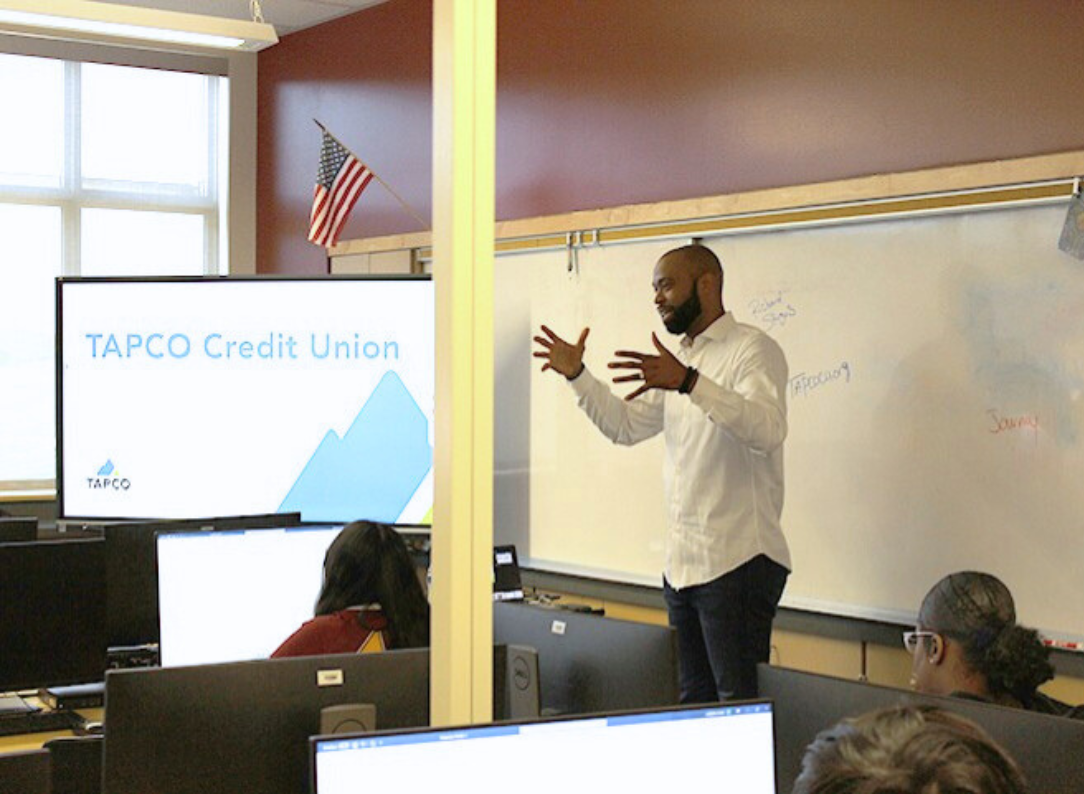
For the past year and a half, TAPCO Credit Union has partnered with Mr. Gibbs and his students at Baker Middle School to support financial literacy as part of everyday classroom learning. This work is not a single presentation or one-time lesson. It is sustained, hands-on instruction embedded directly into the classroom, focused on practical money skills students can connect to real life.
At the middle school level, students are already forming habits around saving, spending, and decision-making, often without realizing it. Mr. Gibbs sees this as a critical window for learning.
“It is vital that financial literacy begins at the earliest age possible,” he shared. “From the piggy bank age forward. Starting savings early and learning to manage wants and needs to start as early as possible.”
Rather than treating financial education as an add-on, this partnership integrates real-world concepts into regular instruction. Students learn about budgeting, saving, banking, and everyday financial decisions, helping them build comfort with topics that can otherwise feel intimidating or out of reach.
What makes this work especially impactful is consistency. TAPCO has returned to the classroom over time, building trust and deepening understanding through repeated engagement.
“The level of questions the students ask has deepened,” Mr. Gibbs said. “It is important that they get the latest developments in financial services and especially understand dangerous trends that can impact youth who are about to enter high school and start part-time jobs.”
That continuity has helped shift how students think about money and financial security. Mr. Gibbs has noticed changes not just in participation, but in mindset.
“It is opening doors for students around money security,” he explained. “Many still think about keeping cash in their rooms.”
Students themselves have reflected on how these lessons are shaping their understanding of money and their confidence in using financial tools.
“I appreciate Mr. Stirgus because he informed us on how to start a savings account and or checking account,” one eighth-grade student shared. “He gave us an opportunity to open a checking account at our age and taught us how to use and spend our money smartly instead of spending it on things that are not necessary.”
Another student noted the broader impact of learning about financial institutions and their role in the community.
“It was great to hear about money and its importance, and the ways TAPCO has changed and is willing to change different people’s financial lives,” the student wrote. “The opportunity given to us Tacoma students were appreciated and very generous.”
Interactive learning has been key to keeping students engaged. Lessons often include role play, discussion, and real-life scenarios that allow students to apply what they are learning.
“They are very engaged when it comes to role play,” Mr. Gibbs said. “Giving them pretend money and acting out the opening of accounts is almost like a theater experience. They really enjoy searching for their first car and talking through down payments, financing, and all the other costs that come with a car.”
By tying lessons to future milestones, students begin to see how today’s choices connect to tomorrow’s opportunities. Several students shared that they expect to carry these lessons forward.
“I know that I will use this information to help me with my financial future because of this class,” one student wrote.
For Mr. Gibbs, this work is about more than financial skills. It is about access and long-term readiness, especially for students who may not otherwise receive early financial education.
“Starting early is the key to wealth building,” he shared. “It is vital for underserved communities to have access to financial literacy to support their future.”
By showing up consistently and meeting students where they are, this partnership supports financial education as a core part of learning, helping students build confidence, awareness, and skills that will serve them well beyond the classroom.